BPG Board Attachment
Book and Paper Group Wiki > Book Conservation Wiki > Board Attachment
This page describes the various methods of securing book boards to a text block. Boards can be attached individually to each side of the text block, or they can be attached to an outer covering first, with this unit then attached to the textblock. In general, boards are either sewn, laced, or glued on, and often a combination of these techniques is used.
These methods describe the new binding of books. For a discussion of treatment techniques for reattaching detached boards, see Board Reattachment.
Wiki Compiler: Mitchel Gundrum
Wiki Contributors: Pam Barrios, Chris McAffee please add your name here
Copyright 2026. The AIC Wiki is a publication of the American Institute for Conservation (AIC). It is published as a convenience for the members of AIC. Publication does not endorse nor recommend any treatments, methods, or techniques described herein. Information on researching with and citing the wiki can be found on the Reference and Bibliography Protocols page.
Cite this page:
American Institute for Conservation (AIC). "BPG Board Attachment." AIC Wiki. June 9, 2026. https://aic.wikiworks.com/wiki/BPG_Board_Attachment.
Sewn Boards
The same sewing thread used for leaf attachment (rather than any additional sewing support) is used to attach boards. Examples of this structure include historical Ethiopian bindings and Gary Frost's "sewn board" binding.
-
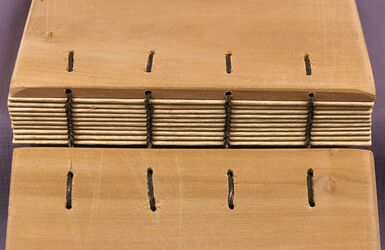 Ethiopian binding model with sewn boards (outside)
 -
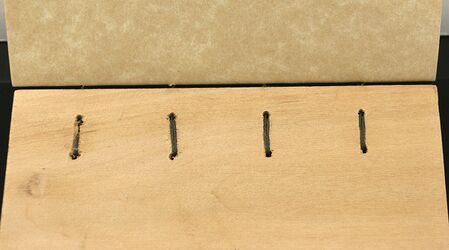 Ethiopian binding model with sewn boards (inside)


Laced Supports
In a supported sewing system, the supports extend beyond the textblock spine and are used to secure the boards. Common supports are cords , thongs, and tapes. These extended supports are fed through pre-made holes, and grooves or channels may also be cut to recess the supports, which are then secured in placed or “fixed” with paste or animal glue, creating a combination of mechanical and adhesive board attachments. Extensions of sewn endband cores can also be used as additional attachments.
-
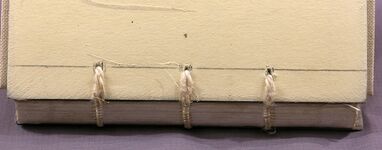 Cord sewing supports run across the outside of a board and laced into pre-drilled holes
 -
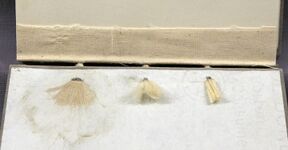 Cord sewing supports which are frayed out and pasted to the inner face of a board


Laced Limp Case
In a laced limp case system, a pre-formed covering piece (generally paper or parchment) is attached to the textblock using extended sewing supports which are laced through pre-formed holes. The system still called limp or semi-limp when floating (non-adhered) boards are used.
-
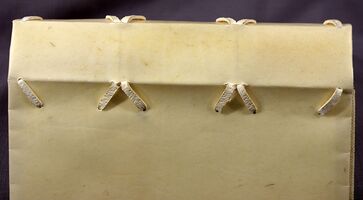 Split alum-tawed thongs used as sewing and endband supports are laced through holes in the limp vellum case
 -
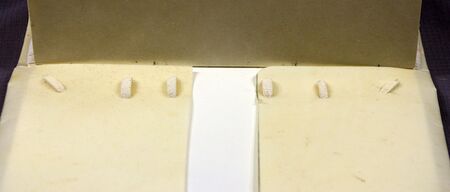 Inside the case, the laced ends of the supports are captured behind extra long head and tail turn-ins. Such bindings may or may not include additional pastedowns.


Adhered Boards
Boards are adhered directly to the textblock before covering, often utilizing extended spine linings, sewing supports, cloth hinges, or endpaper "waste" leaves as additional board attachment. Many variations in materials and construction are possible—the defining characteristic is an in-boards binding that does not include laced supports.
- Please Add Photos!
Split Boards
Extended sewing supports or spine linings are adhered between the two layers of a single board which has either been split (delaminated) or made up in multiple layers.
- Please Add Photos!
Case Binding
In case bindings, both boards are brought together in a single complete covering piece, called a case, which is attached to the bookblock as a final production step.
- Please Add Photos
Selected Bibliography
Clarkson, Christopher. 1982. Limp Vellum Binding, Herts, England: 1982.
Cockerell, Sydney. 1977. Ethiopian Binding, Designer Bookbinders Review.
Levy, Bruce R. The Restoration Rebinding of Speculum Naturale by Vincent of Beauvais, and the Subsequent Development of Several Options for Conservation Rebinding Structures Based on Details Found During the Restoration. The American Institute for Conservation v.6, 1987 http://aic.stanford.edu/sg/bpg/annual/v06/bp06-08.html
Miura, K. T. 1984. My World of Bibliophile Binding. Berkeley: University of California Press.
History of This Page
Prior to the creation of the AIC Conservation Wiki, this page was created as "Section 3 - Chapter 5 - Board Attachment" of the Book Conservation Catalog by Pam Barrios and Chris McAffee. For more see: History of the BPG Wiki.
| Paper Conservation Topics | |
|---|---|
| Supports |
Support Problems · Western Papers · Asian Papers · Non Paper Supports · Papyrus · Parchment · Composite Structures · Three-Dimensional Paper Formats · Foxing |
| Media | |
| Treatment Techniques |
Surface Cleaning · Hinge, Tape, and Adhesive Removal · Washing · Sizing and Resizing · Bleaching · Enzymes · Chelating Agents · Alkalization and Neutralization · Humidification · Consolidation, Fixing, and Facing · Backing Removal · Mending · Filling of Losses · Drying and Flattening · Lining · Inpainting · Inpainting · Parchment Conservation Treatment |
| Specialized Formats | |
| Book Conservation Topics | |
|---|---|
| Structural Elements of the Book |
Endpapers · Endbands · Sewing and Leaf Attachment · Book Boards · Board Attachment · Book Decoration · Fastenings and Furniture |
| Covering Materials |
Animal Skin and Leather · Cloth Bookbinding · Paper Bookbinding · Parchment Bookbinding |
| Treatment Techniques |
Washing of Books · Alkalinization of Books · Leaf Attachment and Sewing Repair · Board Reattachment · Use of Leather in Book Conservation |
| Bookbinding Traditions |
Bookbinding Traditions by Region or Culture · East Asian Book Formats · Ethiopian Bindings · Greek-Style Bindings · Western African Books and Manuscripts |
| Specialized Formats |
Scrapbooks · Atlases, Foldouts, and Guarded Structures · Artists' Books · Caoutchouc Bindings |
| Circulating Collections | |